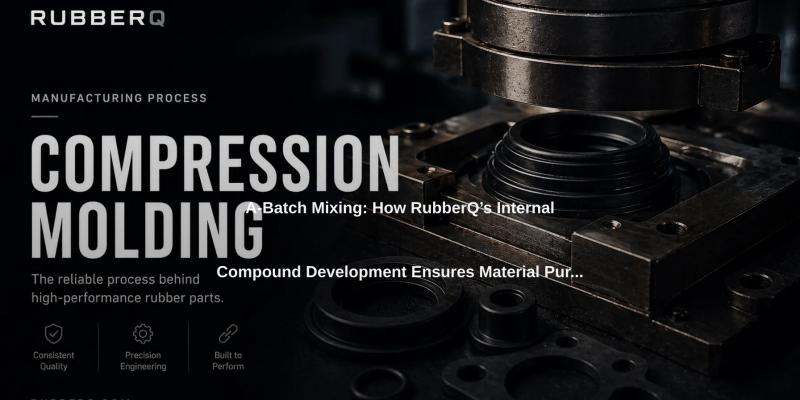
A-Batch Mixing: How RubberQ’s Internal Compound Development Ensures Material Purity
Problem Statement
Third-party rubber compounds often introduce contamination risks, inconsistent filler dispersion, and batch-to-batch variability. These issues lead to premature seal failure in high-temperature (150°C+) or chemically aggressive environments.
Material Science Analysis
Contaminants (e.g., residual processing oils, cross-linked agglomerates) create weak points in vulcanized rubber. RubberQ's in-house A-Batch mixing eliminates this by:
- Controlling raw polymer feedstock purity at 99.7% minimum (ASTM D1418)
- Precision dispersion of carbon black/silica fillers (±2% deviation)
- Closed-loop mixing under ISO 16232 Class 5 cleanliness
Technical Specs
Example: Custom FKM Compound for EV Battery Cooling Manifolds
- Shore A Hardness: 75 ±2
- Tensile Strength: 18 MPa (ASTM D412)
- Compression Set (70h @ 200°C): ≤15% (ASTM D395 Method B)
- Chemical Resistance: Resistant to glycol-water mix (ISO 1817)
| Parameter | RubberQ FKM (In-House) | Generic FKM | EPDM Alternative |
|---|---|---|---|
| Max Continuous Temp | 225°C | 200°C | 150°C |
| Compression Set @ 200°C | 15% | 25% | 50% |
| Glycol Resistance (168h) | ΔV +3% | ΔV +8% | ΔV +15% |
Standard Compliance
RubberQ's IATF 16949-certified mixing process guarantees:
- Material traceability from raw polymer to finished batch
- Statistical process control (SPC) on all compound parameters
- Full ASTM D2000 material callout documentation
For custom material compound development or IATF 16949 documentation, consult RubberQ's engineering department.