Autonomous Delivery Robots: Durable Rubber Tires for Urban Terrain Navigation.
Autonomous Delivery Robots: Durable Rubber Tires for Urban Terrain Navigation.
RubberQ Engineering
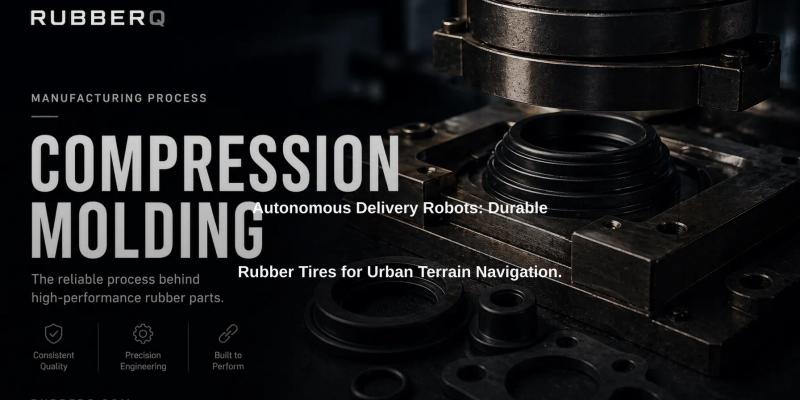
Autonomous Delivery Robots: Durable Rubber Tires for Urban Terrain Navigation
Problem Statement
Autonomous delivery robots require tires that withstand urban terrain challenges: abrasive surfaces, temperature fluctuations (-20°C to 60°C), and exposure to oils, water, and detergents. Standard EPDM tires fail due to poor oil resistance, while NBR tires degrade in UV exposure.
Material Science Analysis
EPDM lacks polar groups, making it susceptible to oil swelling. NBR’s nitrile content provides oil resistance but suffers from UV degradation due to unsaturated double bonds. HNBR (Hydrogenated Nitrile Butadiene Rubber) combines oil resistance with UV stability. Its saturated backbone reduces oxidative degradation, while hydrogenation improves thermal stability.
Technical Specs
- Material: HNBR
- Shore A Hardness: 70 ± 5
- Tensile Strength: 25 MPa
- Elongation at Break: 300%
- Temperature Range: -30°C to 150°C
- Compression Set: 15% (22 hours at 100°C)
- Chemical Resistance: Excellent against oils, detergents, and UV exposure.
Material Comparison
| Parameter | HNBR | EPDM | NBR |
|---|---|---|---|
| Shore A Hardness | 70 ± 5 | 65 ± 5 | 75 ± 5 |
| Tensile Strength (MPa) | 25 | 18 | 22 |
| Elongation at Break (%) | 300 | 350 | 250 |
| Temperature Range (°C) | -30 to 150 | -40 to 120 | -20 to 100 |
| Compression Set (%) | 15 | 20 | 25 |
| Oil Resistance | Excellent | Poor | Good |
| UV Resistance | Excellent | Good | Poor |
Standard Compliance
RubberQ’s IATF 16949-certified process ensures batch-to-batch consistency. HNBR formulations comply with ASTM D2000 for material callouts and ISO 3601 for sealing performance. Adhesion testing follows ASTM D429 for rubber-to-metal bonding integrity.
CTA
For custom material compound development or IATF 16949 documentation, consult RubberQ's engineering department.
Subscribe to Technical Updates
Receive new material insights and engineering case notes directly by email.