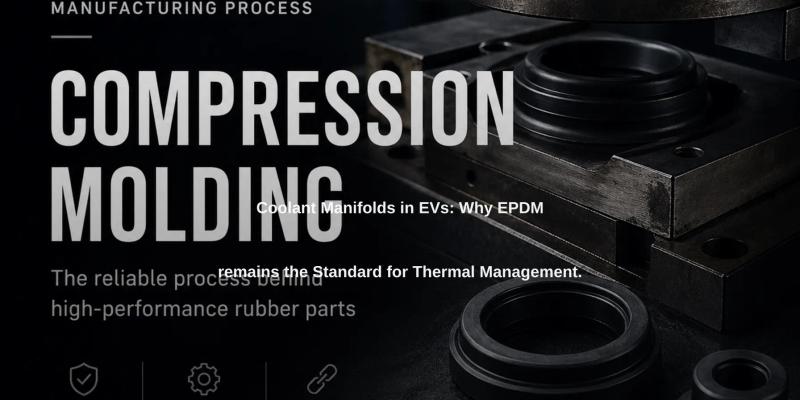
Coolant Manifolds in EVs: Why EPDM Remains the Standard for Thermal Management
Problem Statement
Coolant manifolds in electric vehicles (EVs) require materials that withstand continuous exposure to ethylene glycol-based coolants, temperatures up to 150°C, and cyclic pressure changes. Many polymers degrade chemically or exhibit poor compression set under these conditions.
Material Science Analysis
EPDM (Ethylene Propylene Diene Monomer) excels in this application due to its saturated hydrocarbon backbone. This structure provides superior resistance to heat, oxidation, and polar fluids like ethylene glycol. Fluorocarbon elastomers (FKM) offer higher temperature resistance but fail in cost-effectiveness and compatibility with glycol-based coolants. Silicone (VMQ) struggles with compression set and tear strength.
Technical Specs
- Shore A Hardness: 70 ± 5
- Tensile Strength: 12 MPa
- Elongation at Break: 300%
- Temperature Range: -40°C to 150°C
- Compression Set: 20% (22 hours at 150°C)
Material Comparison
| Material | Temperature Range (°C) | Compression Set (%) | Chemical Resistance (Ethylene Glycol) | Cost Index |
|---|---|---|---|---|
| EPDM | -40 to 150 | 20 | Excellent | 1.0 |
| FKM | -20 to 200 | 15 | Poor | 3.5 |
| VMQ | -60 to 200 | 35 | Good | 2.8 |
Standard Compliance
RubberQ adheres to IATF 16949 standards for batch-to-batch consistency. Our EPDM compounds meet ASTM D2000 and ISO 3601 specifications for sealing applications. Surface preparation and curing processes ensure zero delamination in rubber-to-metal bonding.
For custom material compound development or IATF 16949 documentation, consult RubberQ's engineering department.