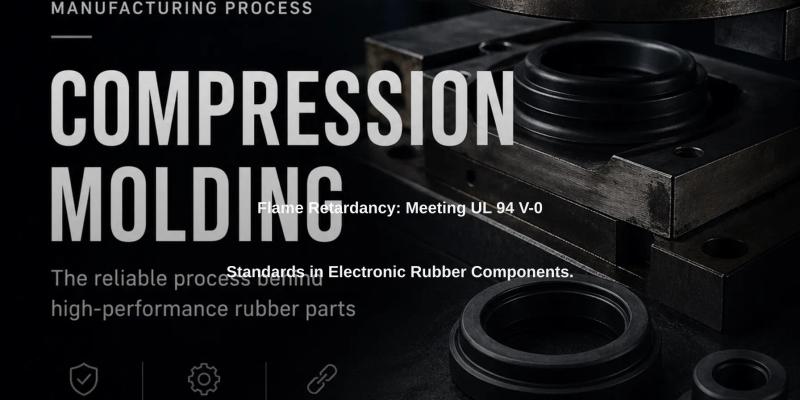
Flame Retardancy: Meeting UL 94 V-0 Standards in Electronic Rubber Components
Problem Statement
Electronic rubber components often fail UL 94 V-0 flame retardancy tests due to insufficient thermal stability and inadequate flame retardant additives. Failures occur when materials ignite, drip, or sustain combustion beyond the acceptable limit.
Material Science Analysis
Standard elastomers like NBR and EPDM lack inherent flame retardancy due to their hydrocarbon backbone. FKM (Fluorocarbon Rubber) succeeds due to its high fluorine content (66-70%), which provides excellent thermal stability and flame resistance. RubberQ’s custom compounding integrates halogen-free flame retardants, such as aluminum trihydrate (ATH) and phosphates, to meet UL 94 V-0 without compromising mechanical properties.
Technical Specs
- Material: Custom FKM Compound
- Shore A Hardness: 70 ± 5
- Tensile Strength: 15 MPa
- Elongation at Break: 200%
- Temperature Range: -20°C to +200°C
- Compression Set (70h @ 175°C): ≤ 20%
- Chemical Resistance: Resistant to oils, fuels, and acids
Technical Comparison
| Material | UL 94 Rating | Temperature Range (°C) | Compression Set (%) | Chemical Resistance |
|---|---|---|---|---|
| Custom FKM | V-0 | -20 to +200 | ≤ 20 | Excellent |
| Standard NBR | HB | -30 to +120 | ≥ 40 | Good |
| EPDM | HB | -50 to +150 | ≥ 35 | Fair |
Standard Compliance
RubberQ’s IATF 16949-certified process ensures batch-to-batch consistency in flame retardant additives and polymer ratios. ASTM D2000 material callouts and ISO 3601 sealing standards are strictly adhered to for quality assurance.
For custom material compound development or IATF 16949 documentation, consult RubberQ's engineering department.