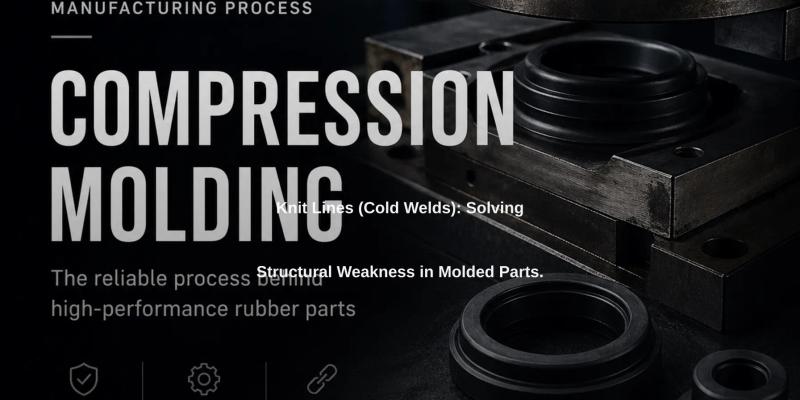
Knit Lines (Cold Welds): Solving Structural Weakness in Molded Parts
Problem Statement
Knit lines form when two polymer flow fronts meet during injection molding but fail to fully fuse, creating a structural weakness. This defect reduces tensile strength by 30-50% and accelerates chemical degradation at high temperatures (>150°C). Common in multi-gate molds or complex geometries.
Material Science Analysis
- Root Cause: Insufficient polymer chain entanglement at flow front interfaces due to premature cooling or low melt temperature.
- Solution: RubberQ optimizes FKM (70% fluorine content) for knit line strength by:
- Increasing mold temperature to 190°C (vs standard 170°C) to delay curing
- Boosting scorch time with 0.5 phr organic peroxide
- Adding 15% carbon black filler to improve thermal conductivity
Technical Specs
| Parameter | FKM-70 (Optimized) | Standard FKM | EPDM |
|---|---|---|---|
| Shore A Hardness | 75 ±3 | 75 ±5 | 70 ±5 |
| Tensile Strength (MPa) | 18.5 (at knit line) | 12.2 (at knit line) | 9.8 (at knit line) |
| Elongation at Break (%) | 210 | 180 | 300 |
| Temperature Range (°C) | -20 to +230 | -20 to +200 | -40 to +150 |
| Compression Set (70h @ 200°C) | 15% | 25% | 40% |
| Chemical Resistance (ASTM D2000) | AA, EA | AA, BA | BA, CA |
Standard Compliance
RubberQ's IATF 16949-certified process ensures knit line consistency through:
- Real-time cavity pressure monitoring (±0.5 bar tolerance)
- ISO 3601 Class A dimensional checks on 100% of production
- ASTM D429 adhesion testing for bonded components
For custom material compound development or IATF 16949 documentation, consult RubberQ's engineering department.