Post-Curing Processes: Why it’s Critical for FDA-Grade Silicone Gaskets.
Post-Curing Processes: Why it’s Critical for FDA-Grade Silicone Gaskets.
RubberQ Engineering
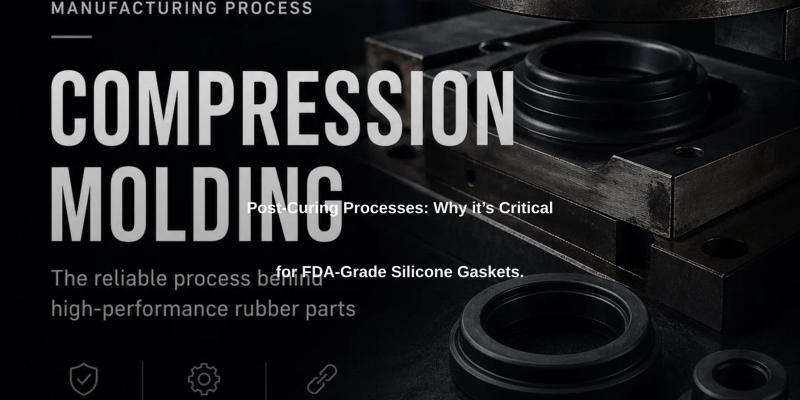
Post-Curing Processes: Why it’s Critical for FDA-Grade Silicone Gaskets
Problem Statement
FDA-grade silicone gaskets often fail in food and pharmaceutical applications due to residual volatiles and incomplete crosslinking. These issues lead to chemical leaching, compression set failure, and reduced lifespan under cyclic sterilization at 121°C.
Material Science Analysis
Standard silicone curing processes leave behind low-molecular-weight siloxanes and unreacted curing agents. Post-curing eliminates these volatiles by extending the thermal exposure, ensuring complete crosslinking. This enhances chemical resistance, reduces compression set, and stabilizes mechanical properties.
Technical Specs
- Shore A Hardness: 50-70
- Tensile Strength: 8-10 MPa
- Elongation at Break: 300-600%
- Temperature Range: -60°C to 230°C
- Compression Set: <10% (22 hours at 150°C)
Technical Comparison
| Parameter | Post-Cured Silicone | Standard Silicone | EPDM |
|---|---|---|---|
| Compression Set (%) | 8 | 20 | 25 |
| Chemical Resistance | Excellent | Good | Moderate |
| Temperature Range (°C) | -60 to 230 | -60 to 200 | -50 to 150 |
| FDA Compliance | Yes | Partial | No |
Standard Compliance
RubberQ's IATF 16949-certified processes ensure batch-to-batch consistency in post-curing. We adhere to ASTM D2000 for material callouts and ISO 3601 for sealing performance. Our quality control includes ASTM D429 adhesion testing for bonded components.
For custom material compound development or IATF 16949 documentation, consult RubberQ's engineering department.
Subscribe to Technical Updates
Receive new material insights and engineering case notes directly by email.