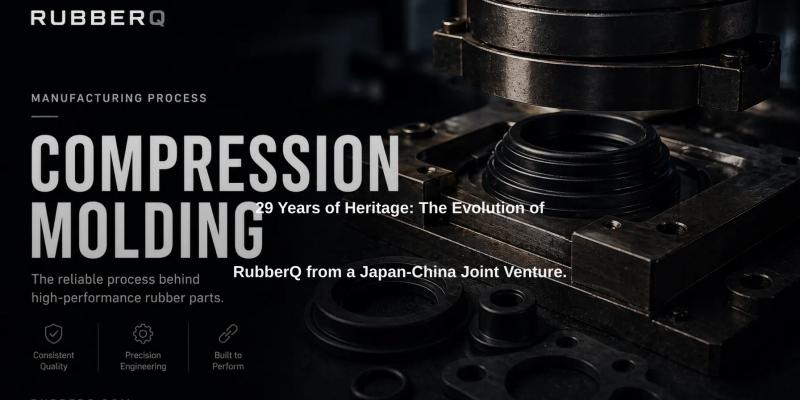
Three Decades of Rubber: The RubberQ Story Since 1995
RubberQ was founded in Fuzhou, China, in 1995 as a Japan-China joint venture. The founding idea still runs the company today: pair Japanese formulation discipline with Chinese manufacturing scale, and hold both to a single standard. This page is the short version of how that idea scaled — and what it means when you evaluate us as a supplier.
The joint-venture starting point
The partnership that formed RubberQ brought Japanese compounding practice into a Chinese factory: documented formulations, disciplined raw-polymer inspection, and a lab-first mindset. Those habits outlived the paperwork — today every compound we run is still developed and mixed in-house rather than resold from a trader's catalog.
From one roof to two plants
Three decades of growth took RubberQ from a single workshop to two plants in Fuzhou totaling roughly 20,000 m². The production chain covers compounding and mixing, molding and vulcanization, secondary finishing, and final inspection — connected by an ERP system that traces each batch from the raw-polymer shipment to the carton that ships.
The lab that keeps the story honest
A heritage claim is only as good as the data behind it. Our in-house laboratory runs rheometers, tensile testers, compression-set fixtures, and heat-aging ovens, so material statements ship with test results, not adjectives. Certifications frame the discipline: IATF 16949:2016, ISO 9001:2015, and ISO 14001:2015.
Where three decades of compounding now focuses
- Precision molded seals for semiconductor equipment, including FFKM components for plasma and wet-process environments
- Micro seals, dampers, and rubber-to-metal bonded parts for robotics
- Gaskets and sealing components for liquid cooling and energy storage systems
- Thermal-management and high-voltage sealing components for electric vehicles
What this means when you qualify suppliers
Every claim on this page has a document or a machine behind it. We welcome remote audits, on-site visits, and third-party inspection — and we answer RFQs with material data, not marketing. That is what Japanese formulation discipline and Chinese manufacturing scale add up to in practice.
To request documentation or arrange an audit, contact the RubberQ engineering team at rubberq.com/contact.