The RubberQ Standard
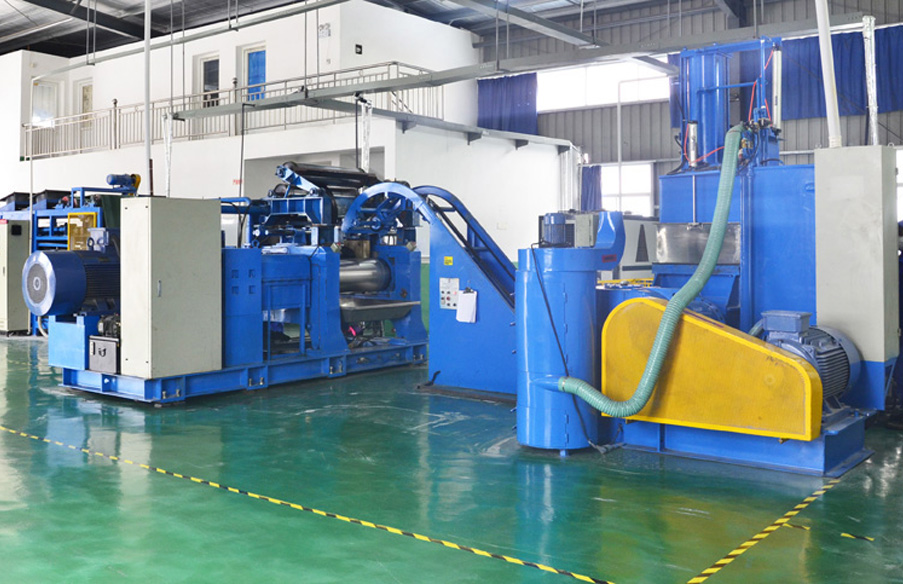
Our two-stage mixing process — run on a single, dedicated A-mixing line designed with our Japanese formulation partners — is the backbone of our quality promise. By separating masterbatching from final compounding, we achieve superior batch-to-batch consistency across years of production for critical EV, semiconductor, and Tier 2 automotive applications.
Manufacturing process
22-Step Controlled Production Flow
From raw material receiving to shipment, every stage has defined equipment, checks, records, and response actions.
The process model is based on RubberQ production-control practice and is presented at a customer-readable level.
Barcode mistake-proofing
Material name, recipe name, batch number, and weight are checked against production instructions.
Defined inspection gates
Incoming, A-compound, B-compound, molding, trimming, final inspection, packing, and shipment all have control points.
Compound release tests
Dispersion, specific gravity, Mooney viscosity, rheometer curve, hardness, tensile strength, and elongation can be linked to the batch record.
Reaction-plan discipline
Each control point is tied to an acceptance rule and documented response path before production continues.
Raw Material & FIFO Control
- ▸ Raw material receiving
- ▸ Storage and controlled warehousing
- ▸ Raw material issue by batch and weight
A-Mixing / Masterbatch Control
- ▸ A-formulation and barcode verification
- ▸ Internal mixing with time, temperature, pressure, and sequence control
- ▸ Calendering, cooling, foreign-matter detection, packing, and A-compound release checks
B-Mixing & Compound Release
- ▸ B-formulation with accelerator and cure-system control
- ▸ B-mixing under process instruction
- ▸ Maturation, cutting, controlled storage, and final compound testing
Molding & Finishing
- ▸ Vacuum compression molding
- ▸ First and last article dimensional checks
- ▸ SPC on critical dimensions and trimming control
Final Inspection, Packing & Shipment
- ▸ Appearance inspection for flash, missing material, cracks, and bubbles
- ▸ Bag and carton quantity verification
- ▸ Shipment check by part number, quantity, lot, and FIFO
Phase 1: Material Sourcing & QC
Raw Material Receiving
Incoming inspection of polymers and chemicals according to IATF 16949 8.4.2 standards.
Controlled Warehousing
Environmental monitoring and FEFO (First-Expired-First-Out) storage management.
Phase 2: Masterbatching (Stage 1 Mixing)
A-Formulation
Precise weighing of masterbatch components using automated dosing systems.
Internal Mixer (A-Mixing)
High-shear mixing in Banbury equipment to ensure uniform dispersion of fillers.
Calendering & Cooling
Sheet extrusion followed by rapid cooling to stabilize the compound.
Masterbatch Testing
Verification of Mooney viscosity and specific gravity before moving to stage 2.
Single-Line Mixing Control
RubberQ schedules compound families by contamination risk, runs SOP-based cleaning between batch families, and keeps A-mixing records tied to the batch. This supports high-purity and long-term repeatability needs without exposing customer-specific recipes.
Learn more about our compounding strategy →Phase 3: Final Mixing (Stage 2 Mixing)
B-Mixing (Final Compound)
Addition of vulcanizing agents and accelerators under strict temperature control.
Maturation/Aging
Controlled storage to allow material relaxation and chemical stabilization.
Final Compound Testing
MDR (Moving Die Rheometer) testing to verify curing curves and performance.
Phase 4: Molding & Finishing
Precision Molding
Utilizing vacuum compression and injection molding for high-tolerance components.
Deflashing & Trimming
Removal of excess material using cryo-deflashing or high-precision manual trimming.
Phase 5: Quality Guarantee & Logistics
Final 100% Inspection
Dimensions, appearance, and physical properties verified against customer specs.
Global Fulfillment
Barcode-tracked packaging and international shipping via port-proximate logistics.
Advanced Process Control
Every batch produced at RubberQ is managed via our integrated ERP system, ensuring 100% traceability from raw material lot number to the final part shipped. We utilize SPC (Statistical Process Control) to monitor critical parameters in real-time.
Zero
Tolerance for Defects