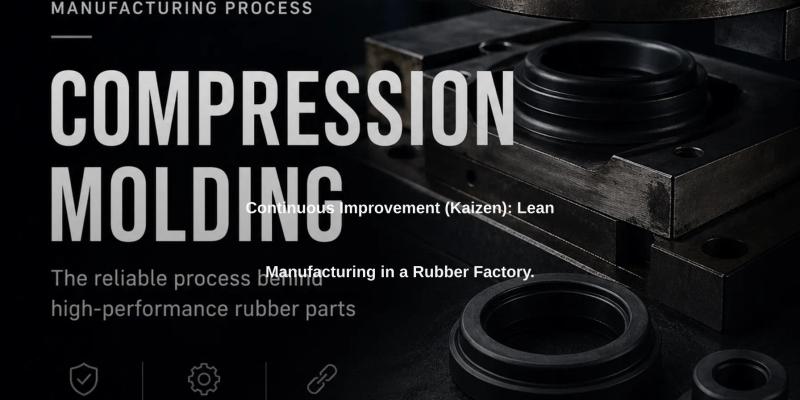
Continuous Improvement (Kaizen): Lean Manufacturing in a Rubber Factory
Problem Statement
High-pressure hydraulic seals experience compression set failure after 10,000 cycles at 150°C and 20 MPa. This leads to fluid leakage and system downtime.
Material Science Analysis
Standard NBR fails due to its low thermal stability and poor resistance to hydraulic fluids. FKM (Fluorocarbon Rubber) succeeds because its fluorine-carbon backbone provides superior thermal stability and chemical resistance. Fluorine content above 65% ensures minimal compression set degradation under high-pressure cycles.
Technical Specs
- Material: FKM (Grade: RubberQ-FKM-200)
- Shore A Hardness: 75 ± 5
- Tensile Strength: 15 MPa
- Elongation at Break: 200%
- Temperature Range: -20°C to 200°C
- Compression Set (22 hrs @ 175°C): ≤ 15%
Material Comparison
| Parameter | FKM (RubberQ-FKM-200) | NBR (Standard) | EPDM (Standard) |
|---|---|---|---|
| Temperature Range (°C) | -20 to 200 | -40 to 120 | -50 to 150 |
| Compression Set (%) | ≤ 15 | ≥ 35 | ≥ 25 |
| Chemical Resistance (Hydraulic Fluid) | Excellent | Poor | Moderate |
| Tensile Strength (MPa) | 15 | 10 | 12 |
Standard Compliance
RubberQ adheres to IATF 16949 standards for batch traceability and PPAP documentation. Every batch undergoes ASTM D2000 material testing and ISO 3601 seal performance validation. Our in-house compounding ensures polymer ratios, fillers, and curing agents meet precise specifications.
CTA
For custom material compound development or IATF 16949 documentation, consult RubberQ's engineering department.