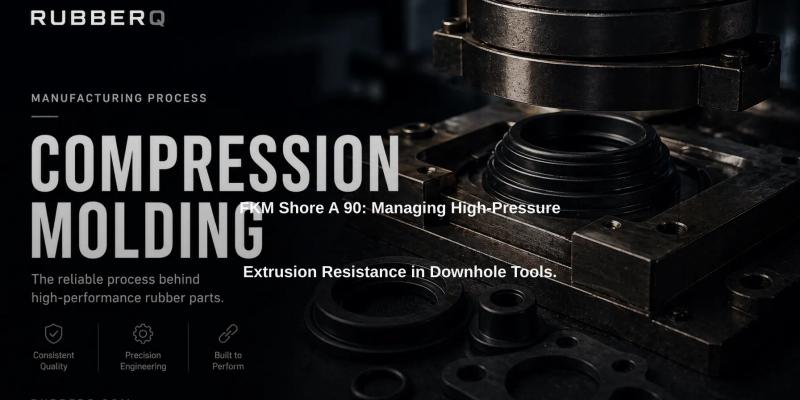
FKM Shore A 90: Managing High-Pressure Extrusion Resistance in Downhole Tools
Problem Statement
Downhole tools operate under extreme conditions: high-pressure extrusion (>10,000 psi), temperatures up to 200°C, and exposure to aggressive chemicals like H2S and CO2. Standard elastomers like NBR and EPDM fail due to chemical degradation and compression set issues.
Material Science Analysis
Fluorocarbon rubber (FKM) excels in this environment due to its high fluorine content (>65%). The C-F bonds provide exceptional chemical resistance and thermal stability. FKM’s molecular structure resists swelling and maintains elasticity under high-pressure cycles, preventing extrusion failure.
Technical Specs
- Shore A Hardness: 90 ± 5
- Tensile Strength: 18 MPa
- Elongation at Break: 200%
- Temperature Range: -20°C to +200°C
- Compression Set: 15% (22 hours at 200°C)
- Chemical Resistance: Excellent against H2S, CO2, and hydrocarbons
Technical Comparison
| Parameter | FKM Shore A 90 | NBR Shore A 90 | EPDM Shore A 90 |
|---|---|---|---|
| Temperature Range (°C) | -20 to +200 | -40 to +120 | -50 to +150 |
| Compression Set (%) | 15 | 45 | 30 |
| Chemical Resistance (H2S) | Excellent | Poor | Fair |
| Tensile Strength (MPa) | 18 | 12 | 10 |
Standard Compliance
RubberQ’s IATF 16949-certified process ensures batch-to-batch consistency. FKM Shore A 90 complies with ASTM D2000 (Material Callouts) and ISO 3601 (Hydraulic Seals). Adhesion testing follows ASTM D429 for rubber-to-metal bonding.
For custom material compound development or IATF 16949 documentation, consult RubberQ's engineering department.