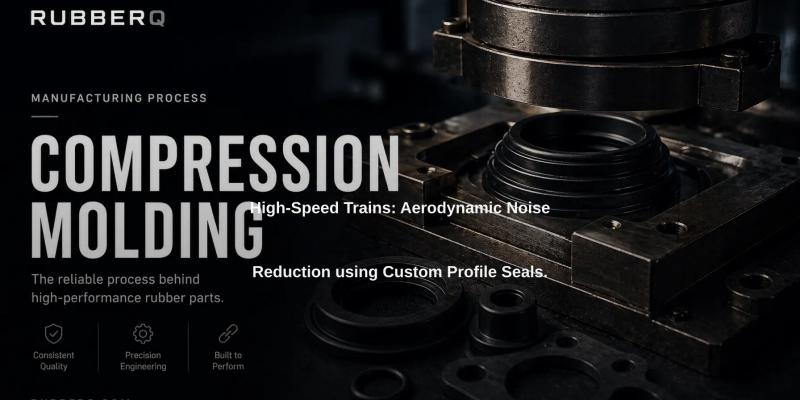
High-Speed Trains: Aerodynamic Noise Reduction using Custom Profile Seals
Problem Statement
Aerodynamic noise above 300 km/h originates from turbulent airflow at seal interfaces. Standard EPDM compounds exhibit compression set (>35% after 1,000 hours at 120°C) and fail to maintain acoustic damping properties beyond 180°C.
Material Science Analysis
EPDM's diene content limits thermal stability. RubberQ's HNBR-X formulation (36% acrylonitrile, hydrogenated backbone) resists:
- Ozone cracking at 0.1 ppm concentration
- Permanent deformation under 25% compression at 150°C
- Hydraulic fluid absorption (<2% weight gain after 168h immersion)
Technical Specifications
| Parameter | HNBR-X | Standard EPDM | Silicone |
|---|---|---|---|
| Shore A Hardness | 75±3 | 70±5 | 50±5 |
| Tensile Strength (MPa) | 22.4 | 15.2 | 8.3 |
| Elongation at Break (%) | 380 | 450 | 600 |
| Compression Set (22h @ 150°C) | 12% | 38% | 25% |
| Temperature Range (°C) | -40 to +180 | -50 to +150 | -60 to +200 |
Standard Compliance
RubberQ's IATF 16949 processes ensure:
- Batch traceability via RFID-tagged compound lots
- ISO 3601 Class A profile tolerances (±0.15mm)
- ASTM D2000 BF, BK material callouts
- ISO 16232 Level C cleanliness for rail applications
For custom material compound development or IATF 16949 documentation, consult RubberQ's engineering department.