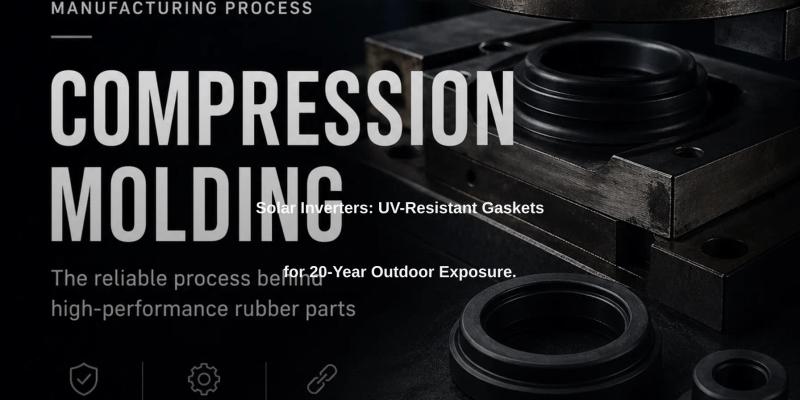
Solar Inverters: UV-Resistant Gaskets for 20-Year Outdoor Exposure
Problem Statement
Solar inverter gaskets face prolonged UV exposure, thermal cycling, and chemical degradation. Standard EPDM compounds degrade under UV radiation, leading to compression set failure and seal leakage over time.
Material Science Analysis
EPDM lacks UV resistance due to its unsaturated backbone. FKM (Fluorocarbon Rubber) excels in UV resistance due to its fluorine content, which forms a protective barrier against UV-induced chain scission. HNBR (Hydrogenated Nitrile Rubber) offers moderate UV resistance but falls short in long-term thermal stability compared to FKM.
Technical Specs
- Material: FKM (Fluorocarbon Rubber)
- Shore A Hardness: 70 ± 5
- Tensile Strength: 15 MPa
- Elongation at Break: 200%
- Temperature Range: -20°C to +200°C
- Compression Set (22 hrs @ 175°C): 15%
- Chemical Resistance: Resistant to UV, ozone, and mild acids.
Technical Comparison
| Material | Shore A Hardness | Tensile Strength (MPa) | Elongation at Break (%) | Temperature Range (°C) | Compression Set (%) |
|---|---|---|---|---|---|
| FKM | 70 ± 5 | 15 | 200 | -20 to +200 | 15 |
| EPDM | 70 ± 5 | 12 | 300 | -40 to +150 | 25 |
| HNBR | 70 ± 5 | 18 | 250 | -30 to +150 | 20 |
Standard Compliance
RubberQ adheres to IATF 16949 standards, ensuring batch-to-batch consistency. All materials comply with ASTM D2000 for material callouts and ISO 3601 for sealing performance. Surface preparation and bonding processes meet ASTM D429 for adhesion testing.
For custom material compound development or IATF 16949 documentation, consult RubberQ's engineering department.