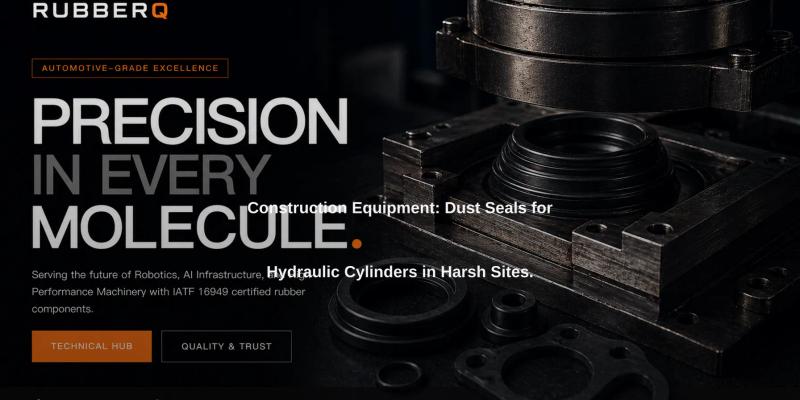
Problem Statement: Dust Seal Failure in Hydraulic Cylinders Under High-Particulate Conditions
Hydraulic cylinder dust seals in construction equipment face abrasive wear from silica-rich environments and chemical degradation from hydraulic fluids. Standard NBR compounds fail at sustained temperatures above 100°C and exhibit compression set >40% after 1,000 cycles at 20 MPa.
Material Science Analysis
NBR's nitrile groups provide oil resistance but lack thermal stability. FKM's fluorine-carbon backbone (66-70% fluorine content) resists oxidation at 200°C and maintains <15% compression set. RubberQ's HNBR variant (43% acrylonitrile, 5% hydrogenation) balances chemical resistance with -40°C low-temperature flexibility.
Technical Specifications
- Material: Custom FKM-HNBR Blend (RubberQ Formula #RX-442)
- Shore A Hardness: 75 ±5
- Tensile Strength: 18 MPa (ASTM D412)
- Elongation at Break: 250%
- Temperature Range: -40°C to +210°C continuous
- Compression Set (22 hrs @ 200°C): 12% (ASTM D395 Method B)
| Parameter | FKM-HNBR (RX-442) | Standard NBR | EPDM |
|---|---|---|---|
| Max Operating Temp (°C) | 210 | 100 | 150 |
| Compression Set (%) | 12 | 45 | 30 |
| Chemical Resistance (IRM 903 oil, 70hrs @ 150°C) | +3% volume swell | +25% volume swell | Not recommended |
| Abrasion Resistance (DIN 53516, mm³ loss) | 40 | 120 | 90 |
Standard Compliance
RubberQ's IATF 16949-certified process ensures:
- ISO 3601-1 Class A dimensional tolerances on all molded seals
- ASTM D2000 M6BG 714 A25 B25 E34 F17 callout compliance
- ISO 16232 Level C cleanliness for hydraulic applications
For custom material compound development or IATF 16949 documentation, consult RubberQ's engineering department.